Radical (2023)
Directed by Christopher Zalla
William T. Harris, US Commissioner of Education from 1889 to 1906, said, and believed: "Ninety-nine [students] out of a hundred are automata, careful to walk in prescribed paths, careful to follow the prescribed custom. This is not an accident but the result of substantial education." Sadly, though this attitude may have served the purpose of feeding the industrial revolution with unfettered parents to work in sweatshops, this mode of education is still the de facto standard. We are still teaching children to be automata, to follow instructions, to derive answers exactly the way the teacher showed on the blackboard, never mind if you understand the underlying principles well enough to arrive at the correct answer through your own reasoning.
I know this personally. I started grad school at Brooklyn Polytech, which was amazing, until it merged with NYU and inherited their professors. My statistics professor was one of "those." He gave me my first master's level B. I brought my final with the supposedly wrong answer that caused the lower grade to him and asked if the answer was correct. He said yes, the answer is correct. (I had derived it from basic theorems.) I asked why, being correct, he didn't change my grade to A. He said because I "didn't do it the exact way he showed in class on the blackboard." That's when I dropped out of grad school. Conformity over comprehension. Obedience over understanding. That's the system that crushes creativity and motivation.
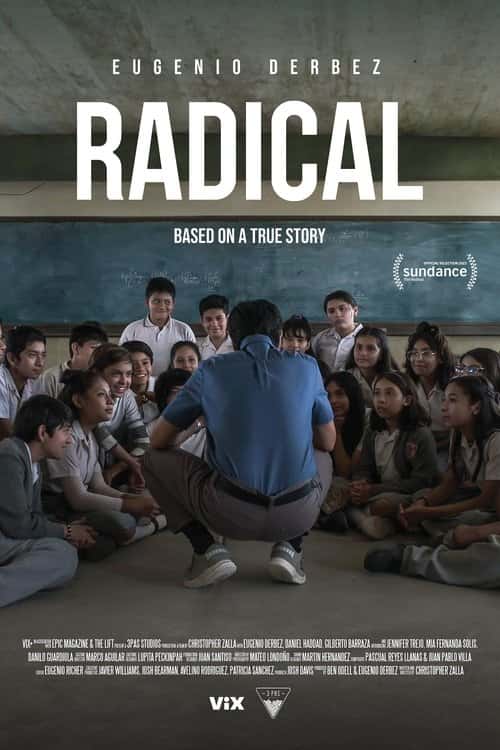
Radical is about a teacher who became totally fed up with that system. Based on a true story documented in a 2013 Wired article, the film follows Professor Sergio Juárez (Eugenio Derbez), who teaches in Matamoros, a Mexican border town plagued by poverty, corruption, and cartel violence. His students come to school hungry, traumatized, convinced they have no future. The standard curriculum, designed to produce automata, offers them nothing. Looking for alternatives, Juárez happened upon the work of Sugata Mitra, the educational researcher who demonstrated that children can teach themselves remarkable things when given access to resources and the freedom to explore their own curiosity. Juárez resolved to try this radical approach in his own classroom. And it was wildly successful.
The film teeters on the edge of appearing to purposely tug at the heartstrings, and in lesser hands it would collapse into manipulation. But I read the Wired article on which this is based, and the film is pretty faithful to the true story. The true story itself, like the film, is both heartrending and heartwarming. These children really existed. Their poverty and trauma were real. And their transformation, when someone finally believed in their capacity to think rather than merely obey, was real too.
All of the children in the film are fantastic and natural. Christopher Zalla did an amazing job here, casting young actors who don't feel like they're performing but simply being. And Eugenio Derbez was as real as it gets, playing Juárez with conviction and warmth, avoiding the moist-eyed sentimentality that could have sunk the role. You believe he cares, you believe he's frustrated, you believe he's willing to risk his career to prove that these kids deserve better than a system designed to break them into compliant slaves.
Yes, this is an inspirational teacher drama, and yes, it hits familiar beats. But it earns them. And more importantly, it makes a case that should be made over and over until the system finally listens: education that suppresses creativity, curiosity, and independent thought is not education. It's training for obedience. And children, especially children living in conditions of extreme poverty and violence, deserve much better than that. They deserve to be treated as capable of genius, not automata.
Radical won the Festival Favorite Award at Sundance, and it deserved it. This is a film that believes in children, in teachers who refuse to accept failure as inevitable, and in the radical idea that maybe, just maybe, if we stop teaching students to walk in prescribed paths and start letting them think, extraordinary things become possible.